The Ultimate Interview Preparation Guide: How to Get Hired in 2026

interview preparation guide

Our interview preparation guide helps you master that moment you receive the interview confirmation, a wave of excitement where you’ve cleared the first hurdle and your CV has done its job. But as the initial excitement settles, the real question creeps in, “How do I actually land the job?” or “What questions are they going to ask me?”


In the evolving South African job market of 2026, where digital presence and cultural fit are just as vital as technical skill, winging it is no longer an option. Regardless of whether you are a recent graduate stepping into your first role or a seasoned professional pivoting to a new industry, the interview is your stage to prove you are the solution to an employer’s problem.

We believe that preparation is the bridge between being a candidate and becoming a colleague and this guide is designed to give you that competitive edge, walking you through everything from deep-dive research to the final, high-impact questions that leave a lasting impression.

1. The Pre-Interview Intelligence Phase

Success starts long before you walk through the door or log onto the call. You need to build a profile of the company.

  • Analyze the Job Description (JD): Don’t just read it, dissect it. Highlight the top three skills they are looking for. These are the pain points the employer has. Your preparation should focus on how you can heal those points.

  • The 3-Tier Research:

    1. The Company: What is their mission? Have they been in the news recently?

    2. The Role: How does this position contribute to the company’s bottom line?

    3. The Interviewer: Look them up on LinkedIn. Finding a commonality (like a shared university or previous company) can be a great icebreaker.

2. Master the STAR Technique

Modern interviews are behavioral. Employers believe that past behavior predicts future performance.

To answer “Tell me about a time when…” questions, use the STAR method to keep your answers structured and concise.

 
ElementDescriptionYour Focus
SituationSet the context.Keep it brief (1-2 sentences).
TaskWhat was the challenge?Define the goal clearly.
ActionWhat did YOU do?This is the meat of your answer. Use “I,” not “we.”
ResultWhat was the outcome?Use data or specific praise received.


3. Preparing for the Big Five Questions in Job Interviews

While every interview is different, these five questions appear in almost every industry. You should have scripts ready for these:

  1. “Tell me about yourself”: The Formula: Past (your background) + Present (what you do now) + Future (why you want this specific job).

  2. “What is your greatest weakness?”: The Strategy: Pick a real, work-related weakness that is fixable. Explain the steps you are currently taking to improve it.

  3. “Why should we hire you?”: The Strategy: Summarize your “Unique Selling Point.” Match your top three skills directly to the top three requirements in the JD.

  4. “Where do you see yourself in five years?”: The Strategy: Employers want to see ambition but also stability. Show how this role is a logical step in your long-term career path.

  5. “Do you have any questions for us?”: The Strategy: Never say no. Ask: “What does success look like in this role after six months?” or “How does the team handle tight deadlines?”

Handling the Salary Question “What are your salary expectations?”

The Strategy: Avoid giving a single hard number too early. Instead, provide a researched range. The Script: “Based on my research of similar roles in the East Rand/JHB South area and my 15 years of experience, I am looking for a package in the range of [RXX,XXX] to [RXX,XXX]. However, I am open to discussing the full benefits package as well.”

💡Tip: Practice your answers out loud. What sounds good in your head often needs refinement when spoken. Record yourself on your phone to check for “ums,” “ahs,” and pacing.

4. The Technical & Visual Check

In 2026, the how is just as important as the what.

For Virtual Job Interviews:

  • Lighting: Ensure the light source is in front of you, not behind you (which creates a silhouette).

  • Eye Contact: Look directly into the webcam lens, not at the person’s face on the screen. This mimics real eye contact for the interviewer.

  • The Mute Rule: Stay on mute when the interviewer is giving a long explanation to avoid background noise interference.

For In-Person Job Interviews:

  • The 15-Minute Rule: Arrive in the parking lot 15 minutes early, but only walk into the building 5 minutes early.

  • Non-Verbal Cues: A firm (but not crushing) handshake, upright posture, and active nodding show engagement and confidence.

The 2026 AI & Digital Filter

  • The One-Way Video Interview: Many SMEs now use automated tools where you record answers to a screen. Treat the camera like a person. Don’t read from notes—the AI software often tracks eye movement to see if you are being authentic.

  • The Digital Savvy Question: Be ready for the question: “How do you use AI tools (like ChatGPT or Copilot) to improve your work efficiency?” Showing you are comfortable with modern tools is a huge competitive advantage today.

interview preparation guide

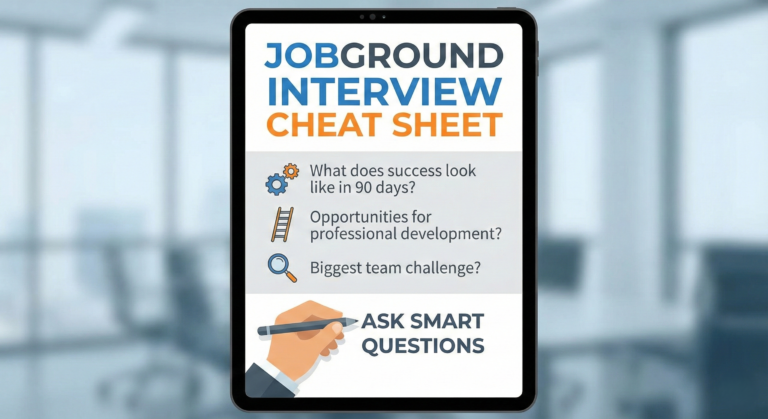
10 High-Impact Questions to Ask in a Job Interview

When the interviewer asks, “Do you have any questions for us?” use these to stand out. Pick 2 or 3 that feel right for the conversation.

  1. “How would you describe the team’s working style?” (Shows you care about fit).

  2. “What would success look like for this role after the first 90 days?” (Shows you are goal-oriented).

  3. “What is the one thing that surprised you most about working here?” (Gets an honest insight into culture).

  4. “Are there opportunities for professional development or upskilling?” (Shows ambition).

  5. “What is the biggest challenge the team is currently facing?” (Positions you as a problem-solver).

  6. “How does this department contribute to the company’s 2026 goals?” (Shows big-picture thinking).

  7. “What is the company’s approach to innovation?” (Shows interest in longevity).

  8. “Who would I be reporting to directly, and what is their management style?” (Shows you want to align with leadership).

  9. “Is there anything about my background you’d like me to clarify?” (The “Power Move” to address any doubts).

  10. “What are the next steps in the process, and when can I expect to hear back?” (Essential logistics).

💡Tip: Don’t ask all 10! Pick 3 that feel most relevant to the conversation you just had. Write them down in a notebook and bring it with you. It’s perfectly acceptable to refer to your notes at the end of an interview.

Post-Interview: The Golden Follow-Up

The interview doesn’t end when you leave the room.

  • The 24-Hour Rule: Send a personalized thank-you email within 24 hours.

  • The Value Add: In your email, mention one specific thing you discussed. For example: “I really enjoyed our conversation about your upcoming expansion into the Western Cape. It sounds like an exciting challenge.”

The job market can feel daunting, but remember, South African employers are looking for your energy, your local insights, and your willingness to learn. Use this guide, prepare thoroughly, and go into that room knowing you have value to add.

We wish you the best of luck! 


Share on: